SURF's Offerings
SURF's Digital Services for Research and Development
SURF is the ICT cooperative for Dutch education and research institutions. They provide high-performance computing (HPC) and storage infrastructure essential for cutting-edge research.
If you are unsure which solution fits your research or need help with resource estimation, contact the RCS team for a consultation.
What is a cluster computer?
A cluster computer is a group of interconnected computers (nodes) working together as a unified system. Each node has its own CPU, memory, and disk space. This allows users to run hundreds of computational tasks simultaneously, making them ideal for high-performance workloads.
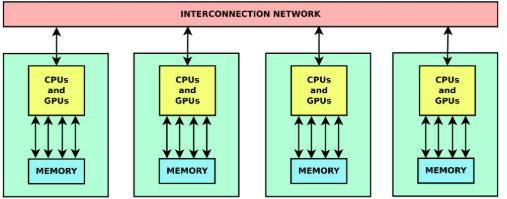
Available SURF Computing Services:
1. Snellius Cluster – The Dutch National Supercomputer
Snellius is the Dutch National supercomputer hosted at SURF. The system facilitates scientific research carried out in many Universities, independent research institutes, governmental organizations, and private companies in the Netherlands. Snellius is a cluster of heterogeneous nodes built by Lenovo, containing predominantly AMD technology, with capabilities for high performance computing (parallel, symmetric multiprocessing). The system also has several system-specific storage resources, that are geared towards supporting the various types of computing.
2. Spider Cluster - High-performance Data Processing (DP) platform
Spider is a versatile DP platform aimed at processing large structured data sets. Spider is an in house compute cluster built on top of SURF’s in-house elastic Cloud. This allows for scalable processing of many terabytes or even petabytes of data, utilizing many hundreds of cores simultaneously, in exceedingly short timespans. Superb network throughput ensures connectivity to external data storage systems. Spider is used for large scale multi-year data intensive projects, for users to actively process their data, such are large static data sets or continuously growing data sets. Examples include genomics data, astronomic telescope data, physics detector data and satellite earth observations.
3. SURF Research Cloud (SRC)
SURF Research Cloud is a service to facilitate scientists’ collaborative work. The central idea in SRC is collaborative workspace. A workspcae translates directly to a "Virtual Machine". These hosted workspaces aka virtual machines can be used for conducting research and development individually or together with your team/project members.
4.Research Data Storage Services
SURF provides several storage solutions depending on your data's lifecycle:
- Data Archive: For safe, long-term archiving of petabytes of data with high accessibility and reproducibility.
- Data Repository: A web-based platform for data publication. Includes persistent identifiers (DOI and Handles) for datasets and files.
- dCache: A massive scalable system (50+ petabytes) using both tape and disk storage, accessible via multiple authentication protocols.
- Object Store (S3): Based on Ceph RGW, this is ideal for massive amounts of unstructured data (organized in containers rather than a directory tree).
How to Get Started
The RCS team assists researchers with navigating these services:
- Grant Applications: We help you apply for SURF/NWO grants:
- Small applications: Up to 1 million System Billing Units (SBU) and/or 100 TB storage. (More info here).
- Large applications: For projects requiring customized, large-scale resource allocations.
- Resource Estimation: We help you calculate how many "System Billing Units" your project will require.
- Use Case Analysis: We assess which specific SURF service (Snellius, Spider, or SRC) is the most efficient fit for your code and data.
Contact us:
For any questions, email us at: rcs-ub@maastrichtuniversity.nl